
Agentic Proficiency - The New Premium SaaS Valuation
Every decade or so the software industry undergoes a major shift in the way software is built and delivered. From 1995 to 2005, the industry moved from on-premise servers to software as a service (SaaS) exemplified first by Salesforce. By 2015 there was the cloud. Now in 2026 we’ve entered the time of Agentic Engineering.
If you’ve gone through a number of these technological revolutions, you begin to see patterns emerge. Engineers haven’t been the only ones to take notice. Each of these revolutions has improved the unit economics of software, and investors have paid premiums to get the software companies with the best unit economics.
Multitenant SaaS
From 2015 until recently the way to get a premium multiple (8-12x Revenue) as a software company was to run as multitenant SaaS in the cloud. The companies in this model can:
- Tolerate failures and recover quickly
- Rapidly test new features and perform improvements without impacting the customer experience
- Evolve their infrastructure for performance improvements and to improve efficiency
- Onboard customers with maybe a credit card and a signup form, no human intervention required, and almost zero additional marginal cost
These companies commanded a SaaS multiple because they were able to decouple customer growth from headcount. The longer they ran in this manner, the larger the margin accretion. The top quartile of these companies were rewarded by investors handsomely for it.
The companies that could not do these things were tech enabled services companies. They:
- Had a separate environment for every customer
- Required extensive manual backend work for any upgrades, additions, patches etc.
- Generally required customization of some sort as well as custom sales contracts, and conflicting and disparate legal contracts that made the software difficult to release and manage
The market saw them as services companies and contracted the multiples in accordance with the lousy unit economics.
Agentic Proficiency
In 2026, multi-tenancy is now a commodity. No companies are launched anywhere but in the cloud and the patterns for scaling, securing, and operating these environments is well understood. Being able to do these things is no longer a mystery and companies can bring in consultants like me to get them to this reality.
This ability, while by no means easy, is no longer the domain of the most elite companies and a new breed of company is emerging that is able to go even further in improving the unit economics of software: agentic proficiency.
Agentic proficiency is the ability to decouple product evolution and maintenance from linear headcount growth via the use of autonomous agents.
Where in the past we were able to massively scale infrastructure (Ops) without adding engineers, now we can scale product (Dev) development without adding engineers. Where in the past we needed teams of people to go to the data center to cable, rack, and manage servers, we don’t need that anymore. Where in the past, we needed to have more and more Scrum teams to develop new features, we don’t need that anymore.
The Ops in DevOps
A few decades ago if you wanted to manage large scale infrastructure, most likely you would need a lot of operations specialists. You can still see this in legacy companies running in the data center. People at legacy companies need to know how to configure the NetApp, or the F5 load balancer. Many InfoSec people still have not grown out of this stage. I like to say that these people know how to configure things that are hard to configure.
Fortunately or not, those skills are no longer needed. With the rise of Infrastructure as Code (IaC) we can manage tens of thousands of perfectly configured instances or services in the cloud with no additional headcount required. The unit economics are outstanding. LLMs make this even easier.
Modern architectures are built to scale horizontally and when we reach the limits of the current architecture, Ops people understand the patterns to evolve one into another with very minimal, if any, downtime.
Instead of working on editing the configuration of Apache servers, or NetApps, modern Ops people, generally called SREs, are focused on architecture, resilience patterns, performance, and enabling developers to go faster through the self-service portals created by Platform Engineering.
Platform engineering allows Dev to go as fast as they can go. With automated testing, environment provisioning, and deployments, the Devs are only limited by their own processes.
The change in the method of running their teams has already come to Ops (SRE). Developers however still have tons of scrum teams that must be enabled by their SRE counterparts. These teams are limited by:
- What is the right thing to build?
- How should it be built?
- The building itself.
The Dev in DevOps
For the companies that become Agentically Proficient, scaling the act of writing code will be like scaling infrastructure. Generating the code will not be the part that requires a lot of effort. Agentic Proficiency will help to decouple product evolution from labor.
Like the Ops folks before them, the Devs will move to much higher level concerns in partnership with the Ops folks, ironically, still DevOps.
This is not to say that there will never be a need for humans to write code. But certainly things that are boilerplate or routine coding will be performed by agents. There will be special circumstances that will of course require special skills.
This happened when Ops made the transition to high leverage. At first people with coding skills wrote custom code to manage large infrastructure. Then came configuration management like Puppet and Chef. Then those tools were improved upon to become cloud native configuration management like Ansible and Saltstack. Most people are now familiar with Terraform. For many of these tools, you declare the environment you want using YAML and most things can be built.
But regardless of how advanced the basic capabilities of these tools became, there were always circumstances they could not handle. For Puppet I wrote custom Ruby code. For Saltstack, we wrote Python.
The same thing will happen with agentic coding over the next few years. While there will be tons of use cases that will be handled by LLMs, there will always be specialized needs that will require an advanced degree of expertise. Coding isn’t dead, but it will evolve.
Harness Engineering
Research has shown that AI is an amplifier. It magnifies an organization’s strengths or accelerates existing dysfunctions. So how do companies harness agentic engineering and become agentically proficient? Harness engineering.
Harness engineering means putting the structural elements in place to leverage autonomous agents for margin accretion.
In many ways, harness engineering is a superset of platform engineering. While platform engineering sped up the process of software development by reducing the wait (waste in Lean) for infrastructure and environments, harness engineering speeds up the process of software engineering by reducing the wait for code to be generated to test hypotheses, run tests, or even production deployments with a suitable harness.
Instead of simply helping an individual developer go faster by giving them tokens on Claude Code, harness engineering ensures that individual productivity gains translate into systemic organizational performance.
By automating the “how” (using the harness to handle code generation/testing), human capital is redirected exclusively to the “what” (market-fit and customer requirements).
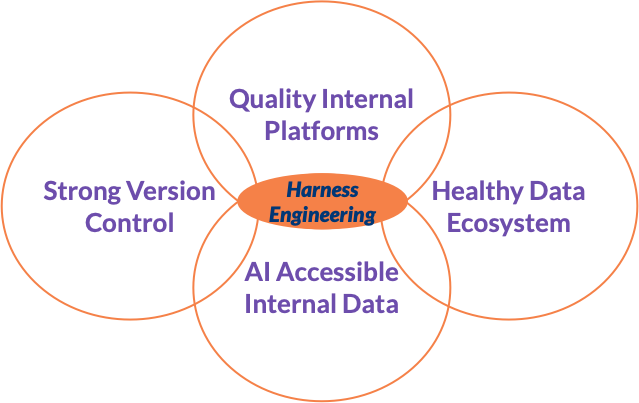
Unsurprisingly, harness engineering leverages most of the same internal capabilities and practices that the research has shown improves both AI adoption as well as success.
Quality Internal Platforms. We’ve already mentioned that harness engineering is a superset of platform engineering. These are all the things that allow agents to develop, test, examine specs, deploy to testing environments, review code, etc. Clearly we can’t have agents developing code and then a team of humans test them. The research is clear: the success or failure of your AI strategy is directly related to the quality of your internal platform. If your platform is weak or non-existent, AI will amplify your weaknesses.
Healthy Data Ecosystem. If data is the moat that companies will use to defend their SaaS offering, then you need a healthy data ecosystem. There need to be well established paths for the intake, management, storage, and utilization of the data. If the production data is bleeding into the development environment or the data is full of noise, you do not have a healthy data ecosystem. Yes, LLMs are good at dealing with unstructured data, but low quality data means garbage in, garbage out.
AI Accessible Internal Data. Generic foundation models are very capable, but then what sets you apart from the competition? Internal policies, coding standards, incident histories, and more should all be AI accessible so we can have agents trained on those policies and utilize those policies. We can have agents train on the existing codebases and knowledge bases. Without this part of the harness, agents can be fabulous creators of technical debt, fabulous creators of structural EBITDA drag.
Strong Version Control. Agents are going to write a lot of code, they are going to test a lot of changes. Agents are going to have a lot of configuration, policies, and prompts. We can’t run all these agents, we can’t do all these experiments, without the ability to roll forward and back. Just like Ops engineers learned to check all their IaC into revision control, the AI accessible internal data, the code that is written, the experiments that have been tried, all need to be checked into revision control so there is a record of what worked, what didn’t, and what is required to get reproducible results.
Just like multitenancy and cloud before, these elements are foundational to commanding a premium SaaS valuation for software companies. A company with these overlapping capabilities can redirect human capital toward market fit and user requirements while agents handle the “how” of software manufacturing.
The New Premium SaaS Valuation
When private equity began investing in software businesses, there was SaaS, then SRE, then cloud and multitenant SaaS. Now multitenant SaaS in the cloud is table stakes for any modern software business to keep from being priced as a tech enabled service.
Companies now need to be able to develop software quickly to be able to improve the customer experience, protect their positions, and take over new markets.
Top quartile companies with demonstrated agentic proficiency will command premium SaaS multiples. This multiple is no longer just a reward for having a scalable delivery engine (Ops). It’s a reward for having a scalable logic engine (Dev).
If a portco still requires linear hiring to add features or maintain its code base it is operating with a legacy cost structure and will be at a competitive disadvantage. Only by leveraging harness engineering to become agentically proficient can companies differentiate themselves by becoming the top performers in the market and deliver premium enterprise valuations for their private equity partners.